Pillows · Natural-fiber bedding · Sleep position
Adjustable Natural-Fiber Fill: Matching Loft to Sleep Position
The right pillow height is not a fixed number. It is the quiet, personal balance between your sleeping position, your mattress, and the way your head and neck settle into the night. Adjustable natural-fiber pillows offer a considered way to find that balance: add or remove fill, observe how your body responds, and refine the loft gradually.
Kapok is especially interesting in this conversation. Light and airy, it has a buoyant feel quite different from a dense foam core. In an adjustable pillow, that quality lets sleepers experiment with height and fullness rather than accept a profile chosen in advance. The aim is not to chase a perfect posture by measurement alone, but to find a pillow that feels comfortable and keeps the head from being forced sharply upward or allowed to fall too far back.
First, what does pillow loft mean?
Loft describes a pillow’s height, particularly the height it maintains while your head rests on it. A pillow can look full when fluffed and compress considerably under weight; another may appear modest but hold its shape more firmly. That difference matters. The loft you experience in bed is not simply the pillow’s uncompressed height, but the relationship between its fill, construction, your body, and the surface beneath you.
Adjustable fill makes that relationship easier to personalize. An inner zipper or access panel allows some material to be removed or, when spare fill is available, added back. Instead of choosing between a small set of fixed profiles, you can make measured changes until the pillow feels neither too tall nor too flat. This is particularly useful when you are unsure what height suits you, sleep in more than one position, or have changed mattresses.
Loft is only one part of support. Firmness, how quickly a filling compresses, the shape of the pillow, and whether the fill shifts all influence how it feels. A high-loft pillow that compresses easily may feel lower under the head than a firmer pillow of similar dimensions. Natural fibers also have their own character: kapok is light and springy, cotton tends to feel more substantial, and wool has a resilient, gently cushioning quality. These distinctions are worth considering alongside height.
Why sleeping position changes the equation
Your pillow works in the space between your head and the mattress. The size of that space changes with your posture. Side sleeping generally leaves more room between the head and mattress because of the shoulders; back sleeping usually calls for a more moderate lift; stomach sleeping tends to work better with less elevation. These are useful starting points, not rigid rules. Shoulder width, body shape, mattress firmness, and personal comfort all influence the result.
A pillow’s purpose is not to lock the body into a single pose. It should support a comfortable, unstrained position. If you wake with recurring pain or numbness, if discomfort persists despite changing your pillow, or if sleep problems are affecting your daily life, consider discussing those symptoms with a qualified healthcare professional. Pillow choice is a comfort decision, not a substitute for medical advice.
Side sleeping: enough height to fill the gap
For a side sleeper, the head may need more lift than it does when lying on the back, because the shoulder creates a wider space between the mattress and the side of the face. A pillow that compresses too much can leave the head dipping toward the mattress. One that is too full may push it upward. Either extreme can feel uncomfortable, especially across the neck and shoulder.
Start with a loft that seems to support the space without tipping the head noticeably up or down. Lie on your side in your usual position rather than sitting upright to test the pillow. Let the shoulder rest on the mattress, not on the pillow, and give the fill a moment to settle. If the pillow is adjustable, remove or add only a small amount at first. For a shaped pillow, make sure the contour suits your body and that the edges are not pressing awkwardly into the shoulder.
Side sleepers who move between sides may prefer a pillow that redistributes comfortably, or an adjustable design that is not packed so tightly that it resists repositioning. A firmer or more resilient fill can retain structure, but firmness alone does not guarantee a better fit. The important question is whether the settled height feels comfortable across the night.
Back sleeping: a moderate, even cradle
Back sleepers often begin with a middle-of-the-road loft: enough to cushion the head, without lifting the chin toward the chest. The pillow should support the natural curve at the neck while allowing the head to rest comfortably. A lofty, tightly filled pillow may feel as though it is crowding the face forward; an underfilled one may leave the head feeling unsupported.
Adjustable fill can help you find a more nuanced balance. Rather than removing a large handful, make a small reduction and lie back for several minutes. Pay attention to the whole feeling of the position: Is your jaw relaxed? Does the neck feel supported rather than braced? Does the head settle naturally? A brief test is not a guarantee of an all-night fit, but it can help identify whether you are moving in the right direction.
Stomach sleeping: less height is often a sensible start
Stomach sleepers usually have less space between the head and mattress than side sleepers do. A thick pillow can turn the head upward, so a flatter profile may feel more comfortable. Some people prefer a very low pillow or no pillow beneath the head; preferences vary, and comfort remains the guide.
If your adjustable pillow feels bulky in this position, take out fill gradually until it lies flatter without collapsing into an uncomfortable lump. Avoid trying to create a perfectly level line through the body by forcing the neck into position. If you combine stomach sleeping with side or back sleeping, you may need to compromise or consider whether a separate pillow better suits your dominant posture.
A measured method for adjusting kapok fill
Kapok’s light, buoyant character can make an adjustable pillow feel plush without being heavy. Because loose fibers can shift during use, opening the pillow and removing a substantial amount all at once may make the result difficult to judge. A more deliberate process turns adjustment into a small experiment: change one thing, try it in bed, and give the pillow time to settle.
- Begin with the maker’s instructions. Check how the pillow opens, whether the fill is contained in an inner liner, and whether spare fill is available. Follow the manufacturer’s guidance for handling and care.
- Make a modest change. Remove a small portion rather than emptying the pillow to a dramatically different height. Keep removed material in a clean, dry, sealed place if you may want to restore some later.
- Redistribute the fill. Close the pillow securely, then gently shape it so the fiber is spread evenly. A hollow or dense patch can affect comfort just as much as overall loft.
- Test in your usual position. Lie down as you normally would, on the mattress you use every night. Allow the filling to settle beneath your head before deciding whether it feels too high, too low, or comfortable.
- Change one variable at a time. If you change the pillowcase, mattress topper, sleeping position, and fill in the same evening, it becomes difficult to tell what made the difference. Keep the rest of your setup consistent where possible.
- Give the adjustment several nights. A first impression can be misleading. Notice how the pillow feels after it has been in use and whether you wake with a comfortable neck and shoulders. If it is still not right, make another small adjustment.
There is no universal amount of kapok to remove. The useful measure is not a handful or a prescribed number of inches, but whether the pillow supports you comfortably in your actual sleeping posture. Keep notes if you are making several adjustments: “slightly lower, comfortable on the back” is more useful than relying on a hazy memory of the previous version.
The natural-fiber difference: feel, structure, and care
The phrase “natural fiber” covers materials with quite different behaviors. Kapok is a plant-based seed fiber, often appreciated for a light, soft, buoyant feel. Cotton is another plant fiber, but a cotton-filled pillow may feel denser and more substantial. Wool is animal fiber with a springy, resilient character. Each will respond differently to compression, shifting, and care, so the best approach is to judge the finished pillow rather than assume that all natural fills behave alike.
Construction matters just as much as the fiber itself. A zippered, adjustable pillow gives you direct access to the fill, while a stitched or quilted pillow may not be designed to open. An inner chamber can help contain loose material during adjustment. The outer fabric, seams, fill distribution, and pillow shape all contribute to the final feel. Look for clear information about what is inside, whether the fill is adjustable, and exactly how the cover and core should be cleaned.
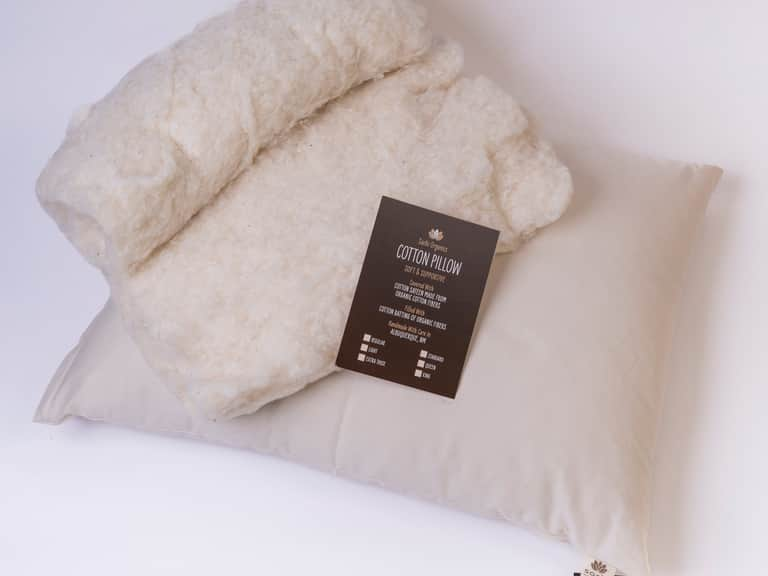
One example of an adjustable natural-fiber option is the Cotton Pillow, described as layered, domestically grown cotton inside an organic-cotton-fiber sateen cover, with a zipper for adjusting loft. Its cotton construction is not kapok, and it should not be expected to feel identical. It does, however, illustrate a practical point: adjustability can be available in more than one natural filling, and the material’s character remains part of the choice.
Natural materials are not automatically washable, hypoallergenic, or environmentally preferable in every circumstance. Those qualities depend on the specific fiber, processing, construction, certifications, sourcing, and care instructions. Treat broad claims with care and look for specific, verifiable information when a particular attribute matters to you.
How mattress and pillowcase affect perceived loft
A pillow is part of a sleep system, not an isolated object. A softer mattress may allow the shoulder to sink more deeply, changing how much space remains beneath the head. A firmer surface may leave the shoulder higher and create a different gap. If you replace a mattress or add a topper, a pillow that once felt right may suddenly feel too tall or too flat.
The pillowcase can make a subtle difference too. A closely fitted case may restrict how freely the fill can spread, while an oversized one can allow it to migrate into uneven pockets. A protector adds another layer and may change the surface feel. Choose a case that suits the pillow’s dimensions and shape, and check whether the product’s maker recommends a protector.
After a major change to your bedding, reassess the pillow before assuming the fill itself has deteriorated. A small adjustment may be all that is needed. Conversely, persistent changes in shape, lumps that will not redistribute, or a damaged seam may indicate that adjustment alone will not restore the pillow’s comfort.
Protecting the fill and preserving its shape
Removable pillowcases and protectors help limit exposure to skin oils, perspiration, dust, and everyday spills. They are also easier to clean than many pillow cores. For kapok and other natural fills, that distinction matters: a washable cover does not mean the filling itself can be put in a washing machine.
Care guidance varies by product and construction. Some adjustable pillows are intended for spot cleaning only; others may have removable, washable covers while the core must remain dry. Never assume that a fiber’s natural origin makes it safe to wash or tumble dry. Water, heat, and direct sunlight may affect fibers or the pillow’s shape, so the maker’s instructions should take priority over generic cleaning advice.
Between washes, follow the product’s recommendations for airing and gentle reshaping. If you adjust fill, work carefully and keep the material in a clean, dry place. Close zippers fully before use, and inspect seams periodically so that loose fibers do not escape. A well-fitting pillowcase can also help preserve the pillow’s surface and make routine care simpler.
Common adjustment mistakes to avoid
- Removing too much at once. A dramatic change can make the pillow feel unfamiliar and difficult to evaluate. Smaller steps are easier to reverse.
- Judging it while sitting up. The pillow is designed to be experienced lying down, with your head carrying its normal weight and your body in its usual position.
- Confusing softness with low loft. A soft pillow may compress substantially; a resilient one may preserve more height. Consider the settled feel, not just how the fill feels in your hands.
- Ignoring a change in sleep position. A pillow tailored for side sleeping may feel excessive when you move onto your stomach. Test the position you actually use most.
- Overlooking uneven distribution. Before removing more fill, gently redistribute what is already inside. A lopsided pillow can imitate a loft problem.
- Washing without checking the label. Cleaning instructions vary. When in doubt, consult the product’s care guidance rather than treating all natural-fiber pillows alike.
A simple comfort check
Once you have made an adjustment, ask a few quiet questions. Does the pillow feel supportive without pushing your head into an awkward angle? Can you settle without constantly folding or bunching it? Does the fill stay reasonably even as you turn? How do your neck and shoulders feel in the morning compared with before?
These are observations, not diagnostic tests. One uncomfortable night does not prove that a pillow is wrong, just as one pleasant night does not establish that it is perfect. A short period of consistent use gives you a better basis for deciding. If the pillow continues to feel uncomfortable, reverse the latest change or test another small adjustment rather than making several at once.
The appeal of a pillow that can evolve
An adjustable pillow offers something more considered than a single, preselected height. It gives you room to respond to the realities of your own sleep: the way a mattress compresses, the position you settle into, the firmness you enjoy, and the small differences between one night and the next. With kapok, that flexibility is paired with a naturally light, buoyant feel; with cotton or wool, the experience will be distinct, even when the principle of adjustability is similar.
Begin with your dominant sleeping position, make changes gradually, and give each version time to prove itself. Protect the fill with a suitable cover, keep it evenly distributed, and follow the maker’s instructions for cleaning. The right loft is rarely discovered by a dramatic transformation. More often, it emerges through a few measured adjustments and the simple relief of waking to a pillow that feels like it belongs.