Bedding & Sleep
Savvy Rest Pillow Fillings for Side, Back, and Stomach Sleepers
A pillow’s most important quality is not its label, but the way its height and feel meet your body. Savvy Rest’s adjustable organic kapok and wool pillows make that relationship personal: add or remove filling, fine-tune the loft, and revisit the fit as your comfort needs change.
There is a quiet precision to choosing a pillow. It sits at the intersection of sleep posture, mattress feel, shoulder width, and personal preference, doing a small but consequential job through the night: supporting the head and neck without forcing them into an uncomfortable angle. The right pillow can feel almost unremarkable. The wrong one announces itself with a cramped shoulder, a tilted chin, or the repeated urge to turn it over and start again.
Sleep position offers a useful first clue. Side sleepers commonly need more height to bridge the space between the outer shoulder and the head. Back sleepers often feel better with a moderate or lower profile that supports the natural curve of the neck without pushing the head forward. Stomach sleepers tend to prefer a much flatter surface, since excess loft can turn the head and strain the neck.
These are starting points, not rigid rules. A broad shoulder, a soft mattress that allows the body to sink, or a habit of shifting positions can change the equation. Savvy Rest’s organic kapok and wool pillows address that variability with removable filling. Rather than asking one factory-set height to suit every sleeper, an adjustable pillow lets you shape its loft to your own routine.
Why adjustable pillow loft matters
Loft is the height of a pillow when it is carrying the head. It is related to firmness, but the two terms are not interchangeable. A pillow can be soft yet tall, or firm yet low. Loft describes how much space it fills; firmness describes how much resistance it offers when compressed. Both affect the position of the head and neck, and neither can be judged from a product name alone.
An adjustable pillow gives you the ability to change that height gradually. Removing a small amount of fill can lower the profile and make the pillow feel less crowded. Adding fill can create a fuller surface for someone who needs more elevation. This is especially useful if you are unsure where your preferred height sits, or if you move between positions during the night.
Fine-tuning is best approached as a slow edit rather than a dramatic overhaul. Make one modest change, sleep on it for several nights, and notice how your neck and shoulders feel on waking. A single night can be misleading: a different bedtime, unusual activity, or an unfamiliar cover may affect comfort. A short trial over several ordinary nights offers a more useful impression.
It also helps to adjust the pillow on the bed where you will actually use it. Mattress firmness influences how deeply the shoulders and torso settle. A sleeper on a yielding mattress may need a different pillow height from someone on a firm surface, even if they share the same sleep position. Your pillow is part of a bedding arrangement, not an isolated accessory.
Side sleepers: bridging the shoulder-to-head gap
Side sleeping creates a distinct space between the mattress and the side of the head. The pillow needs enough loft to fill that space comfortably, while allowing the head to rest in line with the rest of the body. If it is too low, the head can angle down toward the mattress. If it is too high, it can tip upward. Either mismatch may feel awkward around the neck or shoulder.
For side sleepers, an adjustable fill can be especially useful because shoulder width and mattress give vary considerably. A broad-shouldered person on a firm mattress may want more height than a narrower-shouldered sleeper whose mattress lets the shoulder sink. Begin with the pillow at its fuller setting, then remove filling in small amounts if the head feels lifted or the neck seems compressed. If the pillow collapses too far under your weight, adding fill may help it maintain a more supportive profile.
Wool may appeal to sleepers who like a medium-firm feel and the option to customize the height. The Savvy Rest organic wool pillow is described as arriving overstuffed, with fill that can be removed to personalize its height and feel. Its organic cotton casing and adjustable construction make it a natural-fiber option for those who prefer a pillow they can tailor rather than replace when the original loft feels wrong. Explore the Savvy Rest organic wool pillow details for its listed dimensions and care information.
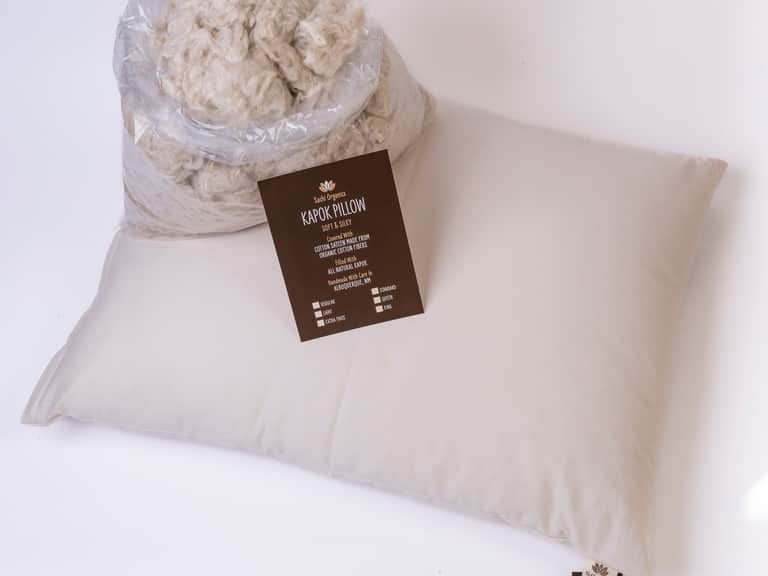
Kapok can be a different kind of experience. The Savvy Rest Organic Kapok Pillow uses kapok fiber, a plant-based filling from seed pods, as an alternative to down. Its fill can be removed or added, allowing you to change firmness and loft. The product information describes a soft organic cotton cover and several size options, including a body size. For a side sleeper, the central question is whether the adjusted pillow remains high enough to support the head without feeling rigid or overfilled. Details are available on the Savvy Rest Organic Kapok Pillow page.
Position matters beyond the pillow itself. Side sleepers may find it helpful to keep the shoulders relaxed and avoid drawing them tightly toward the ears. The aim is a comfortable, neutral resting position—not a pillow that pushes the head into a dramatic angle. Use your own comfort as a guide, and seek professional advice if discomfort is persistent or severe.
Back sleepers: support without pushing the head forward
Back sleeping usually calls for a lower profile than side sleeping, though the ideal height depends on the shape of the neck, mattress firmness, and individual preference. A pillow that is too full can push the chin toward the chest. A pillow that is too flat may leave the head unsupported. The aim is a comfortable resting position that supports the head and neck without forcing either forward or backward.
Adjustable wool or kapok fill lets back sleepers experiment between these extremes. Begin with a moderate amount of filling rather than assuming that a fuller pillow is automatically more supportive. If the head feels tipped forward, remove a little fill. If the pillow feels insubstantial or the neck lacks comfortable support, add a small amount back. Make each adjustment deliberately and give it time.
For a back sleeper who changes position during the night, a middle-ground loft may prove more useful than optimizing for one posture alone. The pillow should feel stable when you settle, but not so tall that a turn onto your side becomes uncomfortable. Some sleepers may prefer to keep a small amount of removed filling available for future adjustment, rather than discard it. The key is to preserve the option to refine the fit as you learn what works.
Filling also affects the sensation of support. Kapok is often chosen for a lightweight, buoyant feel, while wool is associated with a more substantial, resilient character. These descriptions are broad; the final sensation depends on how much fill is inside, the pillow’s construction, and the sleeper’s own perception. The most useful comparison is the way each feels at the height you need, rather than an abstract ranking of materials.
Stomach sleepers: a lighter, lower profile
Stomach sleeping generally places the neck in a turned position, so a high pillow can add an uncomfortable angle. Many stomach sleepers therefore prefer a low profile, sometimes with only a small amount of fill. An adjustable pillow makes it possible to reduce loft rather than trying to compress an overstuffed pillow into a shape it was not designed to hold.
With kapok or wool, remove filling in stages and assess the pillow once it has settled beneath your head. The right setting should feel low enough to avoid unnecessary elevation, while still providing a pleasant surface. If you sometimes roll onto your side or back, you may choose a compromise height; there is no universal setting that suits every combination of posture and body shape.
Stomach sleepers should pay particular attention to how the face and neck feel after a full night, not just during a brief test on the bed. A pillow that feels plush in the hand may still be too tall once it supports the head. The best adjustment is often the simplest one: a flatter, less crowded surface that feels easy to settle onto.
Kapok and wool: two natural fillings, different impressions
Kapok is a soft, lightweight botanical fiber gathered from the seed pods of the kapok tree. In a pillow, it is valued for a light, airy quality and for offering a plant-based alternative to animal-derived fills. Its tactile character can feel buoyant rather than dense. Since comfort depends on construction and the quantity of fiber, it is worth treating material descriptions as a guide to sensation, not a guarantee that every kapok pillow will feel identical.
Wool has a different profile. It is a natural fiber often chosen for its resilient feel and ability to create a stable, substantial pillow surface. Savvy Rest’s wool option is described as medium-firm and customizable, with removable filling. That combination may suit someone who likes a fuller feel at first but wants the freedom to lower it. Wool and kapok are both adjustable in the models discussed here, but the way they compress and feel under the head is not the same.
Neither material is inherently the right choice for a particular sleep position. A side sleeper who prefers a lighter, softer sensation may gravitate toward kapok, while another may prefer wool’s more substantial feel. A back or stomach sleeper can use either material if the pillow can be adjusted to a comfortable low or medium profile. The decision is less about finding a supposedly perfect fiber and more about matching the material’s feel to the loft you need.
Natural does not mean maintenance-free. Fillings have their own care requirements, and pillow construction matters. Check the manufacturer’s current instructions before cleaning, airing, or adjusting a pillow. In particular, do not assume that a removable-fill pillow or its inner core can be machine washed. A washable outer cover, where supplied, is different from a washable pillow core.
A considered method for adjusting your pillow
- Start with your usual position. Choose the posture in which you spend most of the night, then consider whether you regularly move into another one.
- Use your mattress as part of the test. Adjust the pillow on the mattress you sleep on, since shoulder and torso sink can change the height you need.
- Change one thing at a time. Remove or add a small amount of filling, close the casing securely, and let the pillow settle before judging it.
- Give the new setting several nights. Notice comfort while falling asleep and how your head, neck, and shoulders feel when you wake.
- Keep a simple record. A note such as “slightly lower felt better on my side” can help you remember changes and avoid cycling through the same experiments.
- Follow the care guidance. Adjust filling in a tidy area and follow the product’s specific instructions for washing, airing, and handling its materials.
When adjusting a pillow with loose fill, work over a surface that is easy to clean and keep the filling away from drains, pets, and open windows. Reclose the zipper fully before use. If the casing or instructions indicate a specific method, follow that guidance rather than improvising.
Fit, care, and the long view
A pillow’s useful life depends on its materials, construction, care, and frequency of use. Adjustable fill offers one practical advantage: if the pillow feels too tall or too full, it may be possible to alter its profile instead of immediately looking for a replacement. That flexibility is valuable, but it does not mean a pillow will suit every sleeper or remain unchanged indefinitely.
Use a pillowcase to protect the pillow from everyday oils and dust, and wash the case according to its own label. For the pillow itself, follow the product-specific instructions. The Savvy Rest wool pillow listing advises handwashing the outer organic cotton flannel pillowcase in cold water and line drying; the pillow’s wool core should not be treated as washable based on that instruction. The kapok listing likewise specifies care for the outer case. Always check the current product guidance before cleaning, since details can vary by construction and item.
Fit can also change with time. A new mattress, different bedding, a change in sleep habits, or simply becoming more familiar with your preferences may prompt a fresh adjustment. It is reasonable to revisit loft after a few weeks, rather than expecting the first setting to be final. A measured approach—small changes, ordinary nights, close attention—turns pillow selection into a useful process of learning.
Be cautious about promises that a pillow will cure neck pain, prevent snoring, or resolve a sleep disorder. Pillow comfort is personal, and a pillow is not a substitute for medical advice. If pain is persistent, worsening, or interfering with daily life, consult a qualified healthcare professional. The practical aim here is narrower and more attainable: to find a pillow height and feel that are comfortable for your body and sleeping habits.
Choosing between Savvy Rest kapok and wool
Start with sensation. If a lighter, buoyant pillow appeals to you, kapok may be the more natural place to begin. If you prefer a fuller, more substantial feel, wool may be worth considering. Then look at the practical details: available sizes, casing materials, the amount of filling supplied, adjustment instructions, and care requirements. A product’s fiber content is only one part of the decision.
Next, think about your sleep position. A side sleeper will generally be evaluating whether the pillow can maintain sufficient loft to bridge the shoulder-to-head gap. A back sleeper may be seeking a moderate profile that does not push the head forward. A stomach sleeper may want to remove more fill to achieve a flatter surface. In every case, mattress firmness and personal comfort matter alongside position.
Finally, remember that adjustability is an invitation to refine, not a promise of instant perfection. The most elegant bedding choice is often the one that quietly accommodates real life: a pillow that can be altered as your needs become clearer, cared for as directed, and judged by how it feels night after night.
Frequently asked questions
Is a higher pillow always better for side sleepers?
No. Side sleepers often need enough loft to fill the shoulder-to-head space, but too much height can tilt the head in the opposite direction. Shoulder width, mattress firmness, and personal comfort all influence the right setting.
Which filling is best for stomach sleepers?
There is no single best filling for everyone. Many stomach sleepers prefer a low profile, and an adjustable kapok or wool pillow can be reduced to suit that preference. The final choice depends on how the material feels at a lower loft.
Can I wash the entire pillow?
Do not assume so. Care instructions can distinguish between a removable outer case and the pillow core. Check the current product guidance for your specific pillow before washing or using any cleaning method.
How quickly should I decide whether an adjustment works?
Try a small change and assess it over several ordinary nights. Comfort can vary from one evening to another, so a brief test may not give a reliable picture of whether the new loft suits you.